
Seven (Additional) Propositions to the Question: "What is Craft?"
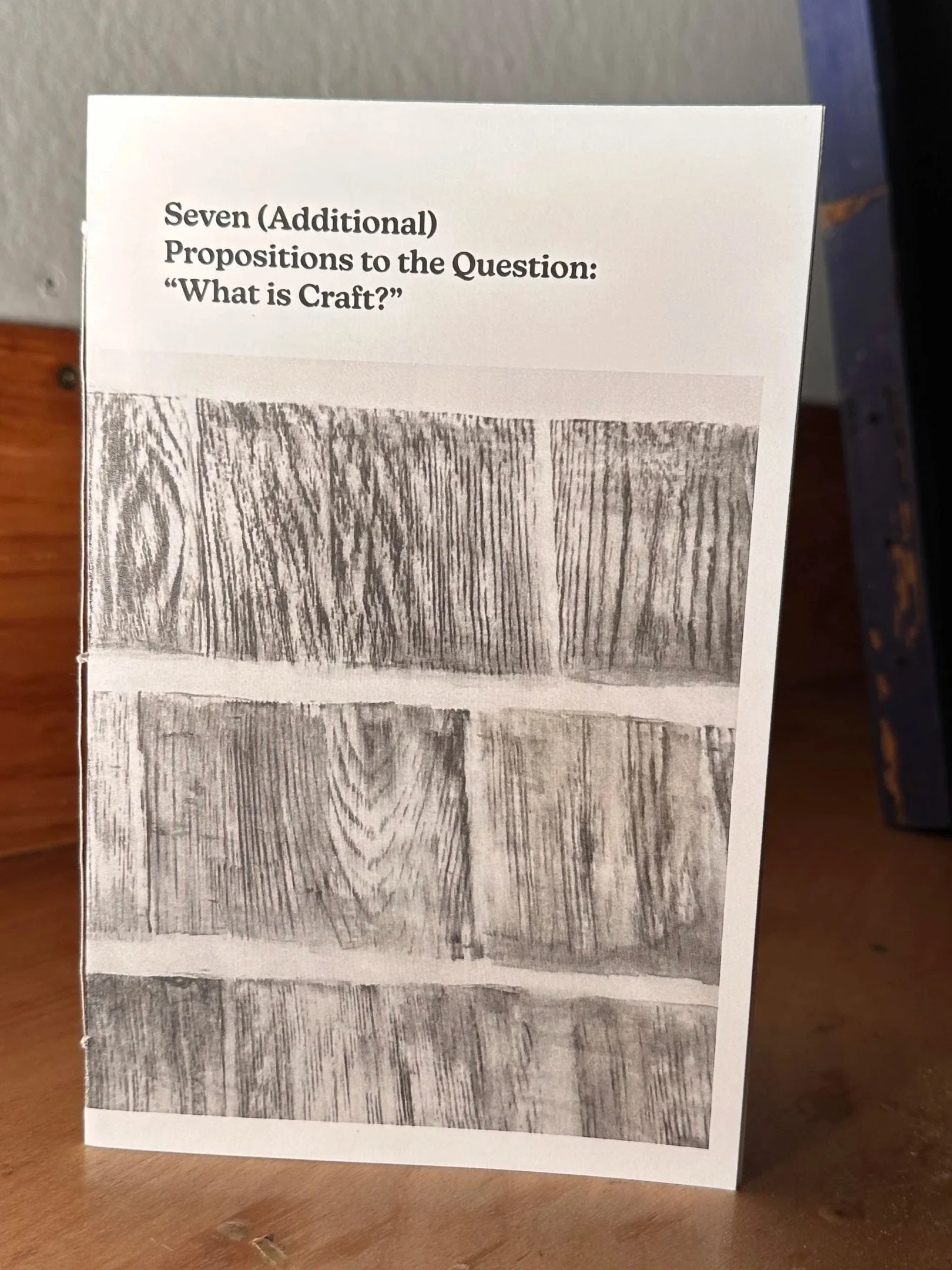
Photo: Robert Alan Grand
Written in response to Julia Bryan-Wilson’s essay, “Eleven (Contradictory) Propositions in Response to the Question: ‘What is Contemporary About Craft?’”
Composed during the workshop, New Ways of Seeing: Writing About Craft in Context, at Haystack Mountain School of Crafts, August 2026.
Debbie Antoon
Victoire Bourgois
Katherine Hackl
Virginia Knight
Jane Lawless
Celine Nader
Robert Alan Grand
Cover art by Victoire Bourgois.
Craft is the physical manifestation one chooses to transform a creative idea into a reality with their individual spin on artistic expression. Caveat: whether appreciated by others or not.
– Debbie Antoon
Craft is the hand. Craft is the eye.
Craft is labor. Craft is skills.
Craft is repetition. Craft is back ache.
Craft is care.
Craft is love.
Craft is learnt by watching.
Knowledge handed down by family and peers, teachers and mentors.
Bill Traylor taught himself how to draw
and paint.
But Jeremy Frey or Theresa Secord did not learn the art of weaving baskets on their
own.
Craft is community.
If there is humility in craft it is because one cannot do it alone. One cannot blow glass alone. Kilns are fired collectively.
Similarly, one cannot parent alone. And yet so many do, out of necessity, out of hubris too.
Parenting is craft.
Parenting is hand, eye, heart, holding, seeing, loving.
Parenting is labor and skills.
Parenting is repetition and back aches.
Parenting is care, love, tenderly knowing and often not knowing.
Parenting is also finding one’s community.
– Victoire Bourgois
Craft is a materials-based set of skills to create objects. Historically, these objects have served the needs of function and ritual. There is a mastery of skill and intention in the use of a medium that can elevate an object from a place of function alone to a place of contemplation. There can be a certain genius in the use of materials and resolution of a design that connects with the mind, body, and heart as you engage the object. It is in this zone where craft is slippery—where it toggles between “art” and “craft”. It can be both, but it is not necessarily both.
– Katherine Hackl
Craft is the collapsed space: between maker and viewer, between beauty and function, between a way of knowing that resides in the world of the mind and the haptic, embodied knowing that lives in the body. In the gallery, in the museum, at the craft fair, at the antique mall, at the estate sale, at the altar of a family heirloom, craft surrounds us in the world of objects. We all have a relational entry point. This perhaps means all points are valid and worthy of consideration. This means there are very few wrong answers.
Craft, then, is a mirror, in which what we find most interesting speaks to our values and what we find important. Craft gives our own world back to us, and in doing so reveals more about ourselves in the interpretation.
– Virginia Knight
Craft is waking up in the morning with the drive to pick up materials and do something with them. To feel a conversation emerge among your eye, your fingertips, the length of your arm, the arc of your back, your entire posture. It’s taking in what you’re working with and considering it, moving it, turning your back on it, growing cross with it, returning to it.
Craft is not knowing when you are finished, stopping for tea, throwing in a load of laundry while puzzling over the materials you are working with. Craft is looking out the window at the light on the trees, listening to the blue jay call, hearing the leaves rustle and still returning, returning, to touch and consider.
Craft is examining the grain of weathered wood and imagining how to recreate those lines with your material and carrying that imagining with you during the day. It’s waking up the next morning with a drive to pick up your materials and do something with them.
– Jane Lawless
Craft is an invitation to participate. In this way, it is profoundly Punk Rock. At once noun and verb, it both holds and is the gesture; the work; the genius; the simplicity; the vigor and finesse and imperfection of the hand. Fine art is by definition well-crafted. Crafts may be embarrassingly lacking in artfulness. Artfulness can be the beating heart of craft. The move to venerate and honor what has often been considered craft—folk arts, historically-women’s work, functional art, indigenous arts, etc.—is a valuable political move akin to William Grant-Still’s Afro-American Symphony. At what point does craft slip into art? Art into craft? The borders are porous, imagined, overlapping as waves and undertow. What are the power dynamics at play in constructing, tending these distinctions? Consider the makers, museums, MFA programs, art schools, marketplaces, critics, curators—their investments in creating / investing in / maintaining these distinctions. Who benefits?
– Celine Nader
Craft is communicative, collaborative, collective, contagious. Seeing one method on display inspires dozens more. Craft acts as dots on a map, forming lines to follow, using the past as a device to plot the future. Craft is tactile, using our hands, our brains, a chisel, a torch. Or a jar of crushed pigments, a microchip, a printer, a kiln.
If art jumps the fence, craft sprints down the gravel road, calling out for others to join in on the parade.
Craft is also about getting out of your own way, facing your fears, and asking for help. Cooperation above competition. When you’re feeling intimidated or trepidatious, craft is there to offer a hand.
It’s the stranger inviting you to come take a dip in freezing cold coastal waters, knowing that both of you will come back to shore feeling revived, refreshed, and ready to begin again.
– Robert Alan Grand
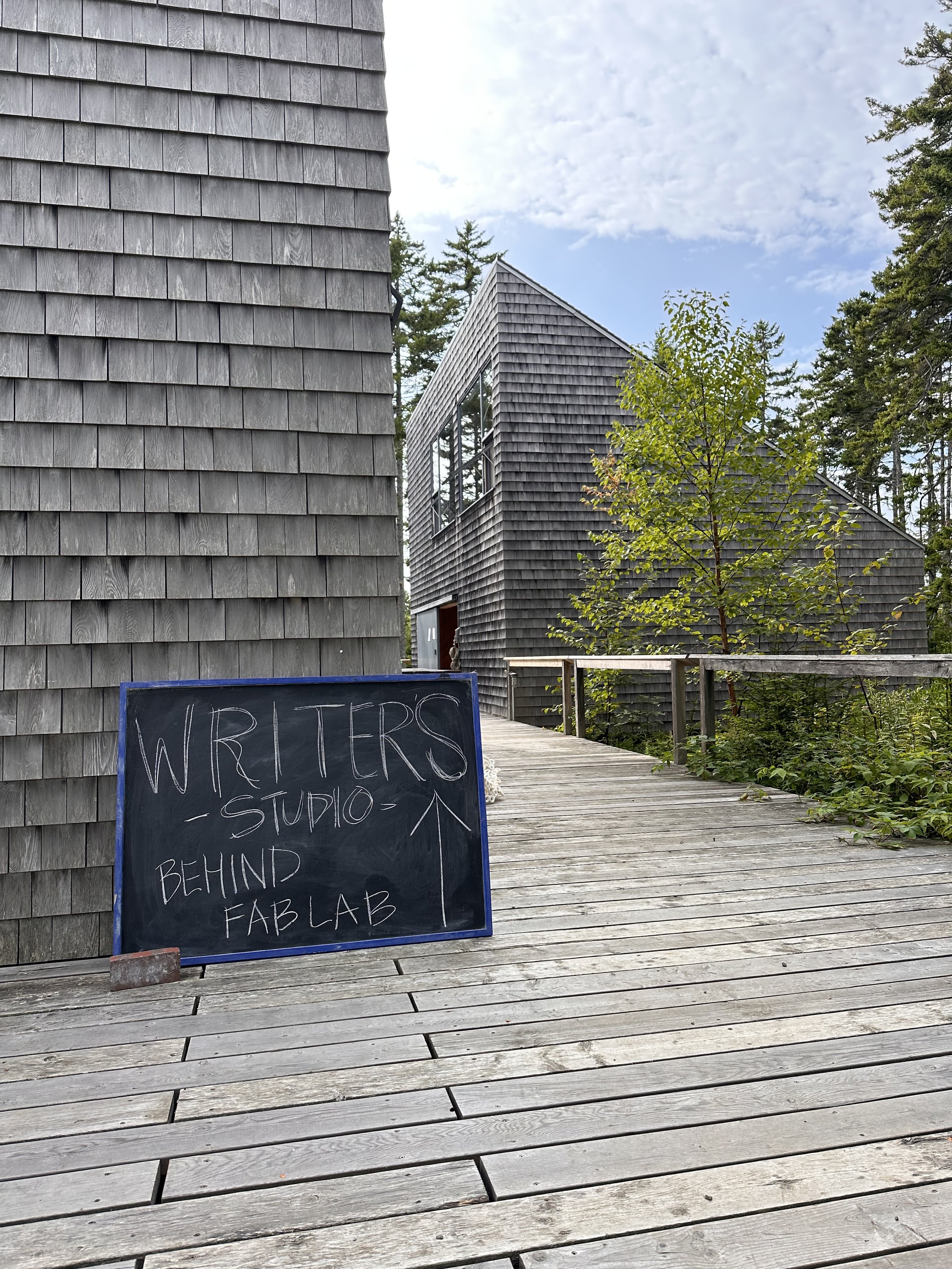
Photo: Robert Alan Grand