
Haystack In A Box Encases Seven Decades of Craft History
From the very beginning, Haystack Mountain School of Crafts has been a place for people of all skill levels to form a creative community, and for many, it became a transformative experience. With seventy-five years of programming under Haystack’s belt, there are countless stories to tell.
While we couldn’t possibly gather and regale you with every individual account since 1951, Haystack Staff and Trustees collaborated to create a time capsule of sorts in honor of this anniversary moment. Haystack In A Box is a curated collection of objects, ephemera, sound, publications, and reproductions of archival brochures and photographs to tell the story of the School, decade by decade and studio by studio.
Each of the disciplines taught at the School is represented in the Box – blacksmithing, ceramics, fiber, glass, graphics, metalsmithing, and wood – along with digital fabrication. Established in 2011, the Haystack Fab Lab is the first digital fabrication lab to be formed at a craft school—a reflection of Haystack’s commitment to expansive ideas about craft. The unofficial seventh studio, the Kitchen, is even represented in the form of Chef Rosemary Foreman’s The Haystack Cookbook, published in 1987.
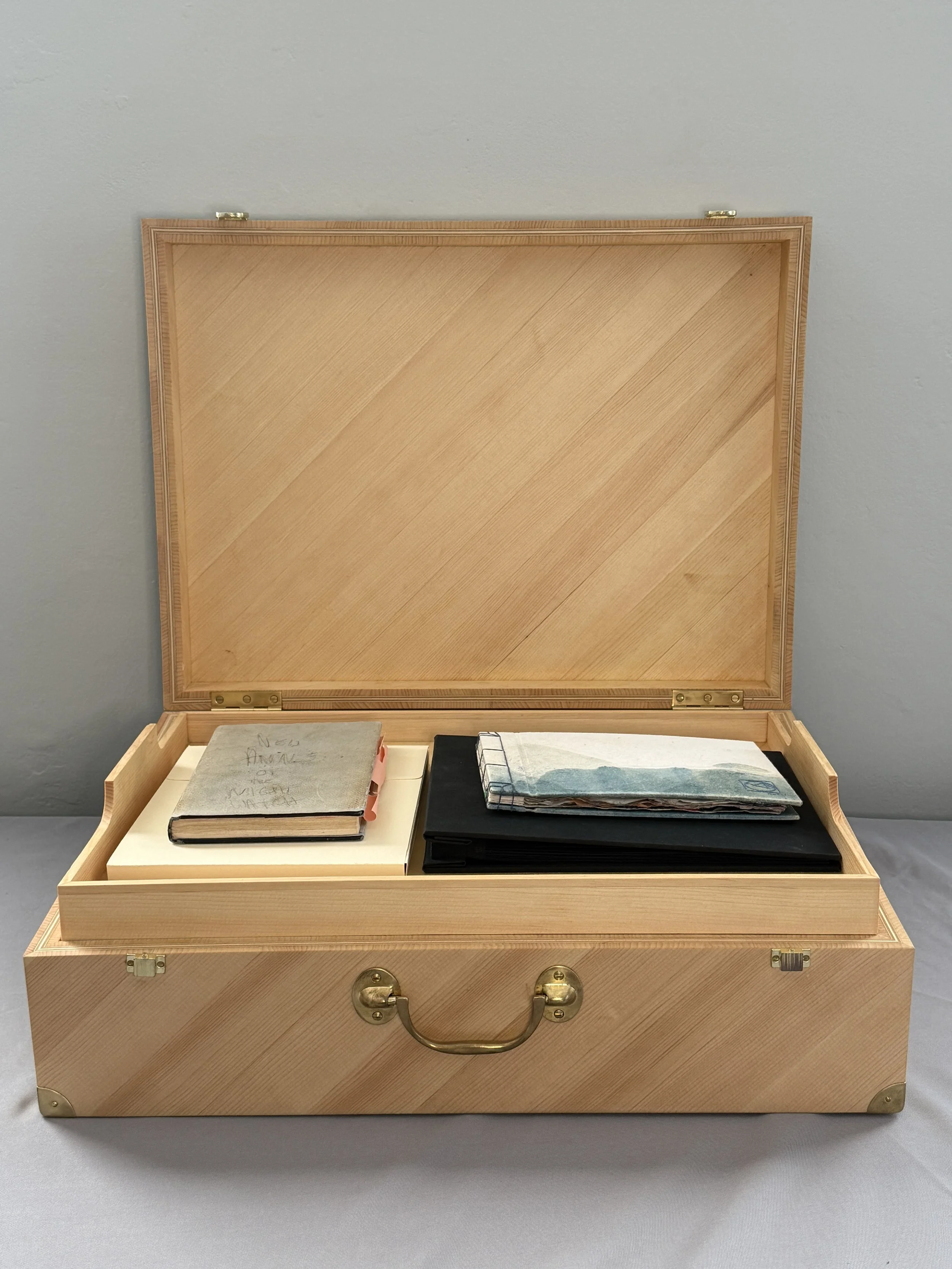
Interior view of Haystack In A Box with tray.
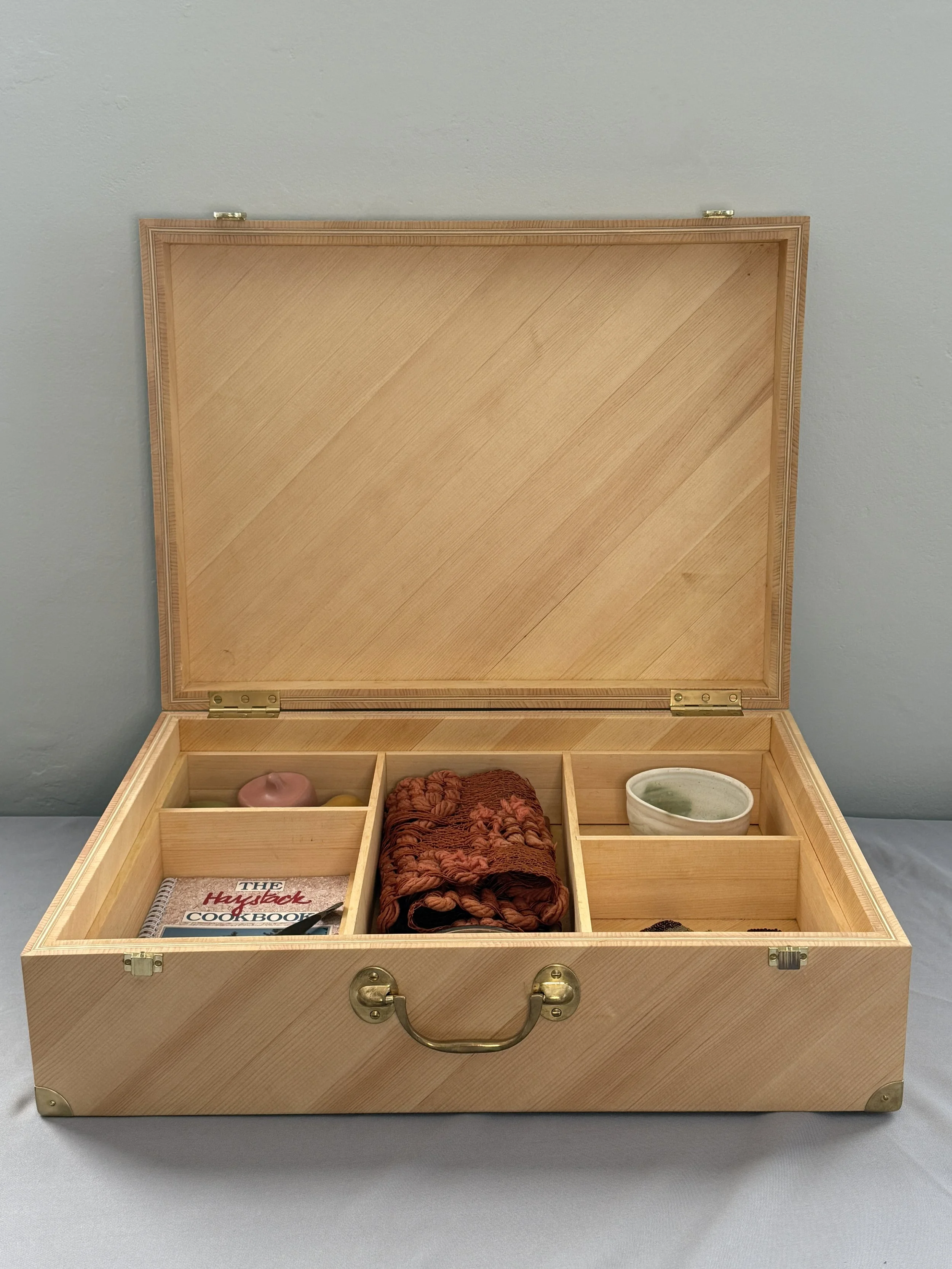
Interior view of Haystack In A Box without tray.
The Box itself was created in about two weeks’ time in the Wood studio by Brad Willis, a Studio Coordinator at Haystack since 2014. The Box was made from resawn pine using the table saw bandsaw jointer and planer. The veneers were glued together diagonally and laminated on a substrate using the vacuum bag. The tray and dividers inside were made using the same materials. Brad shares, “The prompt for the design was to reference the architecture of the School. I didn't want to make it too literal, so I mimicked the campus buildings’ diagonal sheathing using pine wood, and constructed it with mitered corners and minimal fixtures.” He continues, “I fit the dividers in the body of the Box without any fasteners or glue. Each piece has its own space for now, but if the objects change or the idea changes, so can the space.” How fitting that the Box evokes the ethos of our studio spaces.
What’s special about Haystack, beyond its accolades and artists and architecture, is the experience of the place. Haystack is designed to be a place that belongs to the people who are there in the time that they’re there. There is no permanent faculty, no institutional style or fixed pedagogy. Instructors and participants who have visited more than once come to realize that Haystack is almost magically reinvented for each two-week session. The philosophy of the place exists in the collaboration and exchange between its participants. Whether it’s a familiar return or a new encounter, our hope is that Haystack In A Box evokes this Haystack experience.
Executive Director Perry Price will travel with and present Haystack In A Box at various events around the country in 2026 as part of the signature programs celebrating the anniversary. We are especially grateful to all who generously loaned or donated items for this initiative:
Leslie English: Loan of weaving sample of jute and heavy cotton roving by Alice English, 1955
Annie Meyer: Loan of 3 Knotguys (wood), 2021
Steve Norton: Donation of Bell Tower recording and audio files, 2025
Joyce Scott: Donation of 3 Peyote stitch samples, 1976
Claire Sanford: Donation of two J. Fred Woell metal spoons, 1988
Doug Wilson: Donation of Iron Letter Opener, 2025
Toshiko Takaezu: Ceramic bowl, courtesy of Haystack Mountain School of Crafts, circa 1980’s
As Haystack turns 75, we are recognizing milestones and celebrating our traditions, but we are also fostering new growth and navigating new times. To learn how to support Haystack’s ongoing mission to connect people through craft, visit haystack-mtn.org/support.
Haystack In A Box Loans, Donations + Credits
Concept, Materials Outreach, Scripts + Editing
Ginger Aldrich
Rachael Arauz
Sara Clugage
Additional Script Support
Michelle Millar Fisher
Additional Editing
Namita Gupta Wiggers
Artwork + Ephemera
Leslie English: Loan of weaving sample of jute and heavy cotton roving made by Alice English, 1955
Anna Lehner: Donation of glass and cullet
Annie Meyer: Loan of 3 Knotguys (wood), 2021
Steve Norton: Donation of Bell Tower recording
James Rutter: Breadboard assembly for Bell Tower recording, 2025
Claire Sanford: Donation of two metal spoons made by J. Fred Woell, 1988
Joyce Utting Schutter: Donation of print on Linen wall hanging by William & Estelle Shevis (Stell & Shevis), 1950.
Joyce J. Scott: Donation of 3 Peyote stitch samples, 1976
Brad Willis: Box concept and construction, 2025
Doug Wilson: Donation of Iron Letter Opener, 2025
Toshiko Takaezu: Ceramic bowl, courtesy of Haystack Mountain School of Crafts, circa 1980’s
Photo Album + Reproduction Assistance
Seth Birch
Wadiah Mohammed
Cookie Recipe + Dough
Rachael Goldberg
Emily Egan
Rifka Krispi